Adopt’1 Spot
Connaître, comprendre, agir et évaluer, un programme de sciences participatives pour lutter contre les déchets abandonnés, depuis votre territoire.

Why should you adopter un spot ?
Chaque année, 10 millions de tonnes de plastiques finissent dans les océans et 80 % d’entre eux proviennent des terres. Agir à la source est indispensable. Adopt’1 Spot permet de dresser un diagnostic précis de la pollution sur une zone, et d’orienter des actions efficaces et durables.
Les 4 étapes clés
- Connaitre : Ramasser les déchets sur le spot adopté, au moins 3 fois par an ;
- Comprendre : Caractériser les déchets ramassés pour identifier leur origine et leur nature ;
- Agir : Identifier et mettre en œuvre des actions sur le spot pour réduire les déchets abandonnés ;
- Evaluer : Analyser les données et mesurer l’efficacité des actions engagées dans le temps.
Adopt’1 Spot est un outil de sciences participatives qui permet de suivre la pollution par les déchets abandonnés sur une zone précise. En effectuant des ramassages réguliers et en enregistrant les données sur la plateforme Zero Dechet Sauvage, vous construisez un diagnostic local fiable et vous orientez des actions concrètes et efficaces.
Adopter, c'est quoi concrètement ?
- Choisir un spot pollué sur lequel ma structure souhaite intervenir
- Inscrire ma structure sur la plateforme de sciences participatives de MerTerre, Zéro Déchet Sauvage (ZDS)
- Réaliser 3 ramassages par an sur mon spot, caractériser les déchets et saisir les données sur la plateforme ZDS
Associations spots
These spots are intended for all associations, federations and citizens' groups wishing to engage in a monitoring program in a specific area, in order to diagnose the litter and assess the effectiveness of the actions implemented.
Educational spots
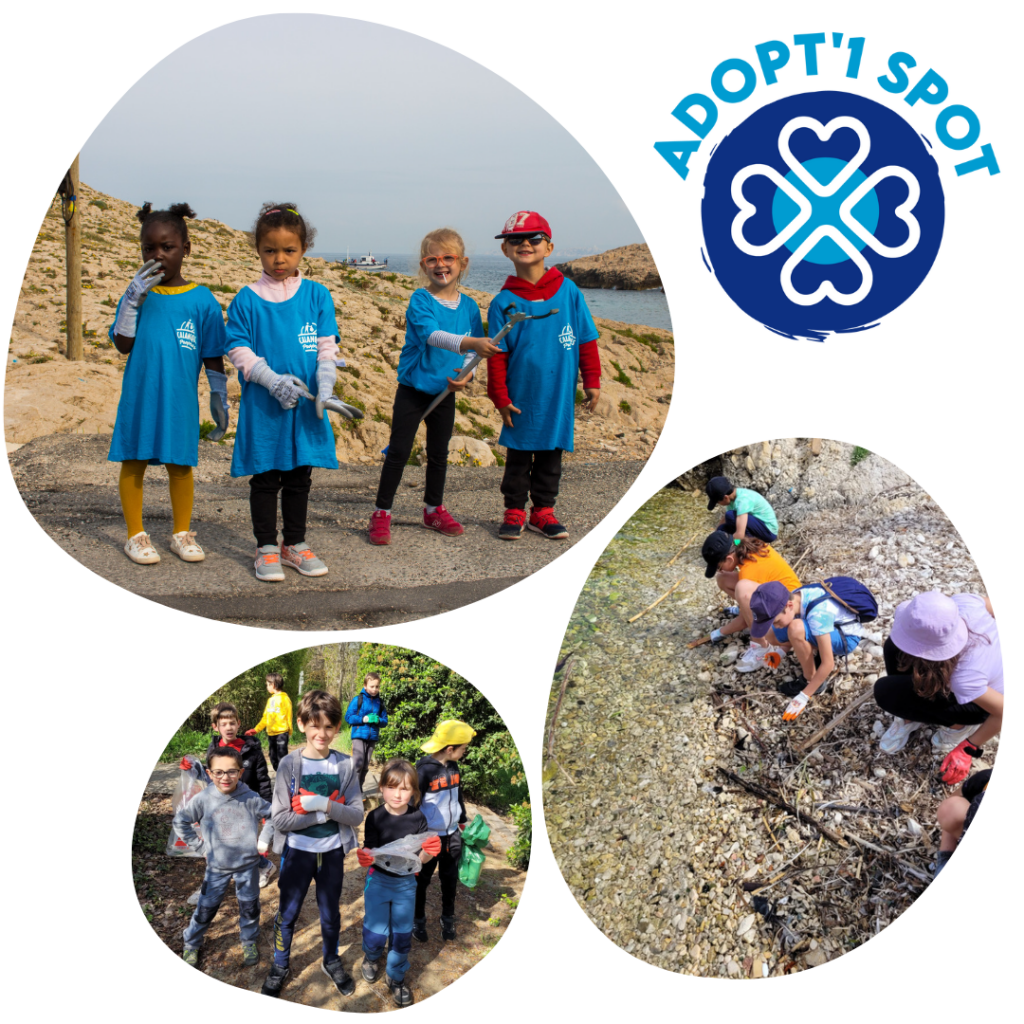
These spots are designed for all educational establishments wishing to introduce young people to the scientific approach, and raise their awareness of the problem of litter, with tailor-made support from the MerTerre association.
Public authorities and managers spots
These spots are intended for local authorities and nature managers wishing to embark on a program to monitor litter, based on studies carried out on one or more indicator areas in their territory. The purpose of this information is to assess, over the long term, the effectiveness of public policies and local actions against litter.
National monitoring spots
These spots cover all the areas covered by the national program for monitoring marine litter on the coast, conducted within the DCSMM and the OSPAR Convention. This program is coordinated in France by Cedre (Centre de documentation, de recherche et d'expérimentations sur les pollutions accidentelles des eaux).
An educational tool to raise awareness
Adopt'1 Spot is also an educational tool that can be used to raise awareness among a variety of audiences, including citizens, schoolchildren and corporate employees.
This program is offered to educational structures to reach as many children and teenagers as possible, who can benefit from tailor-made support from MerTerre.
Acquiring a range of data enables young people to get involved in the management of their region, by alerting local authorities and monitoring the implementation of waste prevention measures tailored to local issues.

Adopt’1 Spot et inscris toi
sur la plateforme Zéro Déchet Sauvage
The origin of the project
The Adopt'1 Spot program originated in the United States and was inspired by the "Adopt a beach" concept. The idea is simple: citizens commit to carrying out several litter picks at a site they symbolically "adopt".
In 2008, the European Union passed the DCSMM (Marine Strategy Framework Directive), which is applied in France through the Marine Action Plan (MAP).
In 2016, MerTerre began working with the French government on adapting the American Adopt a Beach concept to France. In 2019, the regional ReMed Zero Plastic platform was created with the Muséum national d'Histoire naturelle and the Provence-Alpes-Côte d'Azur Region, followed by its national equivalent, Zero Dechet Sauvage with the Ministère de la Transition Écologique. The aim of these participatory science platforms is to federate a network of players and centralize data from collection operations.
Adopt'1 Spot was launched the same year, in 2019, with the aim of making the data collected and recorded on the platform more regular and reliable. Data from one-off collection events often prove to be unreliable, and this is what the Adopt'1 Spot program aims to correct and make usable.